
Brazil Cosmetics Labeling: Portuguese Ingredients, INCI & QR Codes
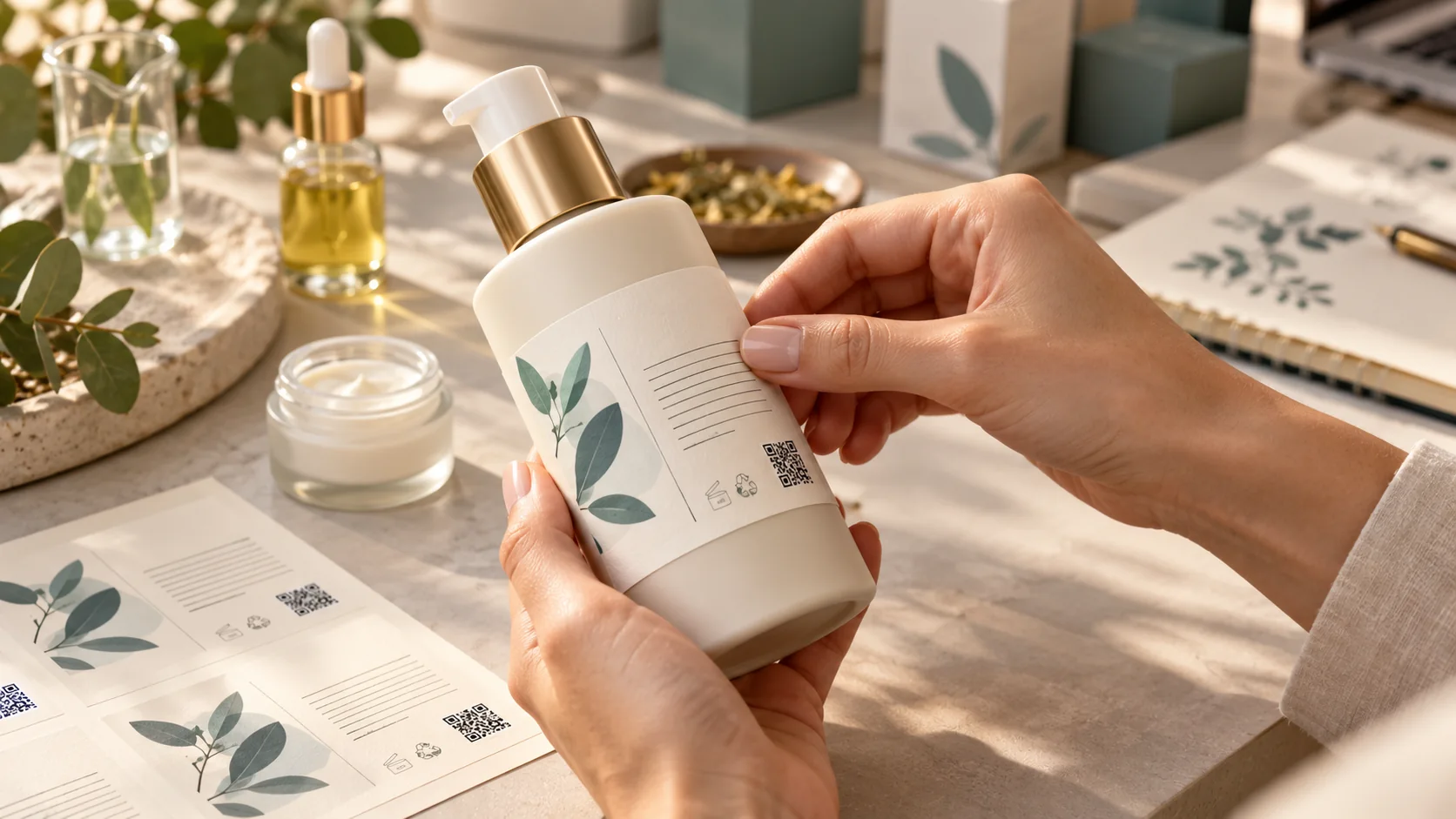
Review Brazil cosmetic label requirements under RDC 898/2024, including INCI, Portuguese ingredient information, permitted digital access and import labeling.
Quick overview
Official-source review: October 19, 2026 · For: International brands, packaging designers, manufacturers and Brazilian import partners preparing retail cosmetics labels.
Translating every line of an English cosmetic label into Portuguese does not by itself complete the Brazilian labeling review. A brand needs to assess required information, the INCI ingredient declaration, Portuguese ingredient information, permitted digital presentation, claims and the differences between imported and final consumer packaging. ANVISA's explanations of RDC 898/2024 are particularly important.
1. What does RDC 898/2024 address?
Official requirement: ANVISA's FAQ on RDC 898/2024 explains that cosmetic labels continue to require the International Nomenclature of Cosmetic Ingredients (INCI) and must also make the chemical ingredient composition available in Portuguese under the applicable rules. The FAQ describes on-pack, suitable label and qualifying digital presentation options. [BR-S06]
ANVISA's 2024 consolidation announcement notes that RDC 898/2024 consolidated and replaced the prior RDC 646/2022 and RDC 773/2023 provisions. Older legislation numbers in historical explanations should be read against the consolidated current regulation. [BR-S02]
The FAQ discusses November 1, 2023 as an important manufacturing-date threshold for implementation. A new 2026 packaging design should not assume that historical remaining-stock cases provide a general exemption. [BR-S06]
2. INCI names and Portuguese ingredient information serve different purposes
INCI provides a standardized international nomenclature used to identify cosmetic ingredients. Portuguese ingredient information addresses how Brazilian consumers can understand composition; an English-language INCI list alone should not be treated as a substitute for a compliant Portuguese presentation. [BR-S06]
Maintain two related records:
- Technical ingredient record: INCI, stable identity, supplier naming, quantitative formula and controlled version.
- Consumer-facing Portuguese record: the translated ingredients for the actual SKU, translation source, relevant display order and final publication method.
Where an ingredient is not yet in ANVISA's official INCI translation panel, its FAQ describes requests for new translations and the circumstances in which a company may proceed with its own translation. Review the current panel and avoid invented consumer-facing equivalents that change the meaning of an ingredient. [BR-S06]
3. Can the Portuguese ingredient list be accessed through a QR code?
Official explanation: ANVISA describes compliant digital access as an option. Its FAQ gives wording such as “Composição (português):” or “Ingredientes (português):” and explains that a code or link should take the consumer directly to the Portuguese ingredient composition for the specific product. Other artwork and petition conditions still apply. [BR-S06]
Do not assume the following satisfy that approach:
- A QR code opening a generic company homepage.
- A code leading to an e-commerce campaign with no clear Portuguese ingredient details.
- A page listing several formula versions without identifying the relevant product.
- A QR destination that stops working during the product's commercial life.
Practical recommendation: If digital composition is used, maintain stable URLs, product-version mapping, content ownership and a defined process for checking live access. Treat these controls as brand operating practices, not as a service or technical guarantee offered by ANVISA.
4. Imported packaging and final consumer labeling are separate checkpoints
Official basis: ANVISA's imported-product labeling FAQ distinguishes certain foreign-language information relevant when goods enter Brazil, lawful local labeling arrangements and the labeling that products must bear when offered or supplied for consumer use. Import feasibility is not permission to market products indefinitely with a noncompliant foreign-language label. [BR-S07]
Before approving mass-produced artwork, ask the importer whether the product will arrive with its final Brazilian label or rely on a permissible local labeling plan. Confirm which entity is responsible for artwork approval, what manufacturing/batch information must be traceable upon entry and whether a special declaration or sanitary condition applies.
Do not interpret a narrowly permitted labeling step at arrival as a blanket waiver of final retail requirements.
5. Seven modules of a Brazil label review
The list below is a working checklist; the actual mandatory wording and fields must be confirmed for the product under the current rules.
- Product identity: Brand, name, real intended function and product category.
- Quantity and traceability: Net content, batch code and applicable manufacturing/expiry details.
- Directions: Application site, use method, frequency and restrictions.
- Warnings: Content relevant to regulated ingredients, product class and target user.
- Ingredient presentation: INCI plus compliant Portuguese information for the correct SKU.
- Responsible parties and origin: Applicable manufacturer, importer, product holder and country-of-origin details.
- Claims: Consistency of Portuguese statements across the primary pack, carton, insert, website and retail listings with actual substantiation.
Products with different shades, fragrances or formulations may need separate version control. ANVISA's FAQ discusses specific cases where different shade presentations may be handled together; do not assume all variants are covered without verifying the conditions. [BR-S06]
6. Common mistakes and better controls
- Mistake: Keeping INCI but omitting compliant Portuguese composition / Better approach: Check RDC 898/2024 and official translation resources; control the final presentation
- Mistake: Using any generic QR code / Better approach: Link directly to the corresponding product's Portuguese composition and meet applicable wording and petition conditions
- Mistake: Translating advertising claims without evidence review / Better approach: Add the Portuguese wording to a claim-to-evidence matrix
- Mistake: Waiting until customs clearance to think about the consumer label / Better approach: Confirm import and final retail labeling plans before shipment
- Mistake: Changing artwork without updating records / Better approach: Keep a record of formula, artwork, filing and review versions
7. Final artwork checklist
- Each SKU's ANVISA classification has been reviewed.
- The INCI list matches the controlled final formula.
- Portuguese ingredient information is accurate and product-specific.
- Any QR code directly accesses the appropriate product composition.
- Directions, warnings, net content and applicable party information have been reviewed.
- Sunscreen, repellent, children's and other special category labeling has been assessed separately.
- Portuguese marketing copy matches the evidence used to substantiate the claims.
- Arrival and retail labeling arrangements have been confirmed with the Brazilian importer.
- Final artwork and approval history are retained.
Frequently asked questions
Can Portuguese ingredient names replace INCI entirely? No such blanket replacement follows from the FAQ. ANVISA explicitly maintains the INCI requirement alongside Portuguese composition information. [BR-S06]
Must every Portuguese ingredient name be physically printed? Not necessarily. The FAQ describes compliant digital approaches, subject to direct product access and prescribed presentation conditions. [BR-S06]
Can an English-language imported package be sold unchanged in Brazil? Do not assume this. Review the actual final retail requirements and permitted import/local labeling arrangements. [BR-S07]
Official Sources
| # | Authority | Document | Locator | Published / Effective | Link |
|---|---|---|---|---|---|
| 1 | ANVISA | RDC 898/2024 cosmetics labeling FAQ | Questions 1, 3, 5, 9, 11 and 17–20: INCI, Portuguese composition, digital access and transition cases | — / — | Official source |
| 2 | ANVISA | 2024 cosmetics regulatory consolidation | Consolidation table: RDC 907/2024 supersedes RDC 752/2022 and related acts; RDC 898/2024 supersedes RDC 646/2022 and RDC 773/2023 | 2024-09-23 / — | Official source |
| 3 | ANVISA | Imported product labeling FAQ | Questions 1–2: foreign-language packaging at import, lawful local relabeling and final consumer labeling | — / — | Official source |
Disclaimer
This article is for general information and does not constitute legal or regulatory advice. Check the official source and your product facts before making a market decision.
Plan your Brazil cosmetics market-entry review
Share the product category, formula, claims, existing reports and intended import route. EasyComply can help organize a source-aware gap assessment.
posts

Brazil Cosmetics Market Entry: ANVISA Registration & Import Guide
A practical guide to ANVISA registration, notification, importer AFE, ingredient checks, labeling, evidence files and import planning for Brazil.

Brazil ANVISA Registration vs Notification: Product Classification
Which cosmetics need ANVISA registration in Brazil? Compare mandatory registration, notification, Grau 1/Grau 2 and the Solicita/Datavisa process.